
AI/ML for 6G network: Latest News and Publications
April 25, 2026: AI-Native 6G: The Future of Intelligent Connectivity
July 4, 2025: Large language models in the 6G-enabled computing continuum
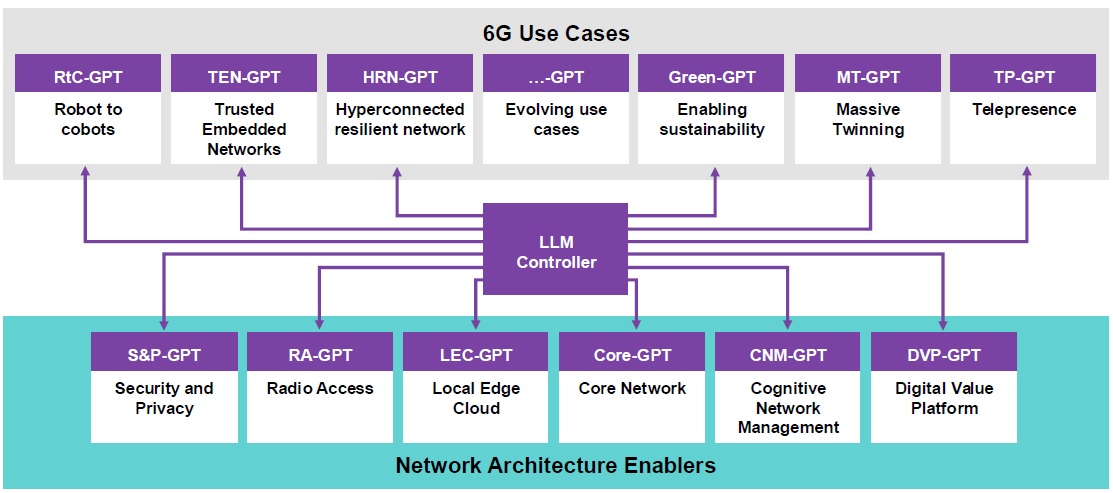
Image from the white paper: Large language models in the 6G enabled computing continuum [1]
The evolution toward 6G networks marks a significant paradigm shift from static, rule-based architectures to adaptive, AI-driven systems. At the forefront of this transformation are Large Language Models (LLMs), particularly Generalized Pretrained Transformers, which offer powerful capabilities for understanding user intent, generating action plans, and executing complex instructions. As such, LLMs are poised to become core enablers of next-generation networks and services. Recognizing this, the authors of this white paper [ 1] discussed AI-native 6G architecture, one that supports the seamless integration, provisioning, updating, and creation of diverse LLMs tailored to specific network functions and applications.
At the heart of this white paper [1] is the concept of the AI-native 6G network that facilitates AI-centric operations across the network. This integrated approach promises transformative benefits such as Intelligent radio and network optimization, improving efficiency and adaptability, context-aware privacy and security.
The convergence of 6G and advanced AI, embodied in scalable, responsive LLMs, will define the future of intelligent connectivity. The time to architect and invest in AI-native networks is now.
[1] Lovén, Lauri, Miguel Bordallo López, Roberto Morabito, Jaakko Sauvola, and Sasu Tarkoma "Large Language Models in the 6G-Enabled Computing Continuum: a White Paper (2025)"
September 14, 2024: Artificial General Intelligence (AGI) for Wireless Systems
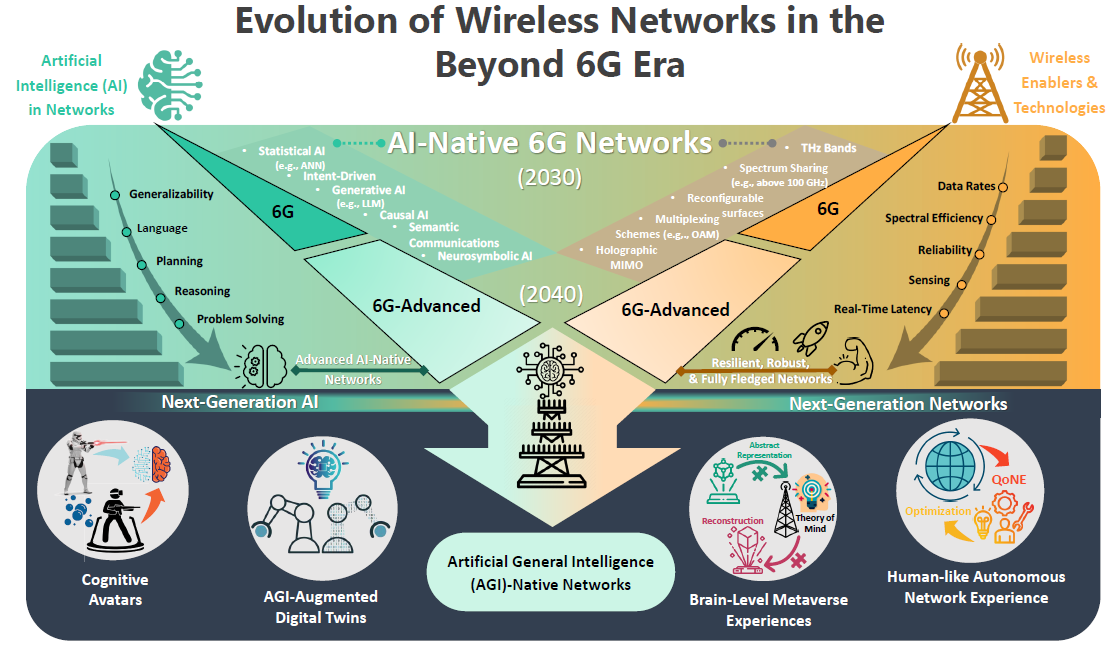
Image from article: Artificial general intelligence (AGI)-native wireless systems[1]
In this insightful article[1], Walid Saad et al. discuss the concept of AI-native wireless systems, proposing their evolution into artificial general intelligence (AGI)-native systems by equipping them with common sense. The authors emphasize that AGI-native wireless systems develop common sense by leveraging various cognitive abilities such as perception, analogy, and reasoning, which allow them to generalize effectively and handle unforeseen situations. The proposed AGI-native wireless system is built around three core components: a perception module, a world model, and an action-planning unit. Together, these components enable four key aspects of common sense: handling unforeseen scenarios through horizontal generalization, understanding intuitive physics, performing analogical reasoning, and filling in missing information.
[1] Saad W, Hashash O, Thomas CK, Chaccour C, Debbah M, Mandayam N, Han Z. Artificial general intelligence (AGI)-native wireless systems: A journey beyond 6G. arXiv preprint arXiv:2405.02336. 2024 Apr 29.
September 7, 2024: 6G and Artificial General Intelligence (AGI)
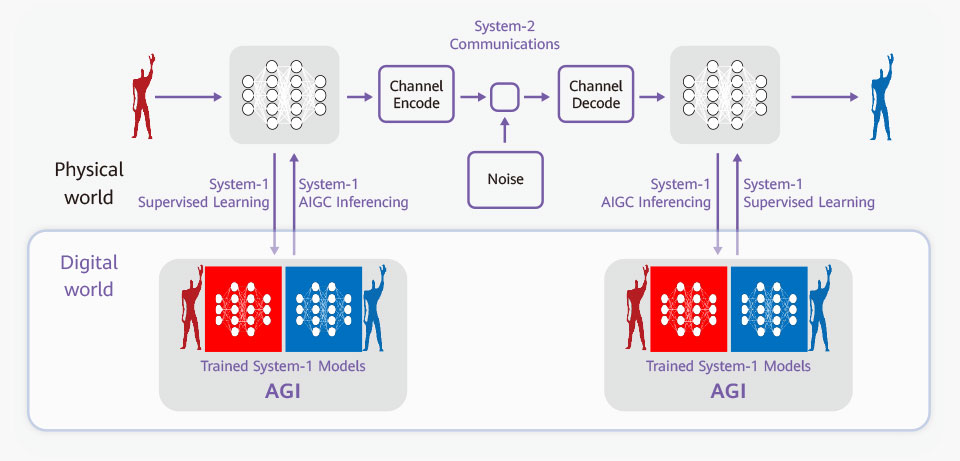
According to Huawei's article, the main platform for 6G services and applications will transition from mobile internet and smartphone apps to AI agents across various sectors. This shift means that AI will act as the key enabler for 6G. In the article, Huawei discussed the role of Artificial General Intelligence (AGI) in networking, along with various types of AI agent-powered 6G communications, such as machine-to-machine intent-driven communication and human-to-machine ultra-reliable low-latency communication.
Date: August 20, 2024: AI for 6G networks, key publications from the literature
- Ali S, Saad W, Rajatheva N, Chang K, Steinbach D, Sliwa B, Wietfeld C, Mei K, Shiri H, Zepernick HJ, Chu TM. 6G white paper on machine learning in wireless communication networks. arXiv preprint arXiv:2004.13875. 2020 Apr 28.
- Kato N, Mao B, Tang F, Kawamoto Y, Liu J. Ten challenges in advancing machine learning technologies toward 6G. IEEE Wireless Communications. 2020 Apr 8;27(3):96-103.
