AI-Native Networks Architecture (6G Vision) from white paper
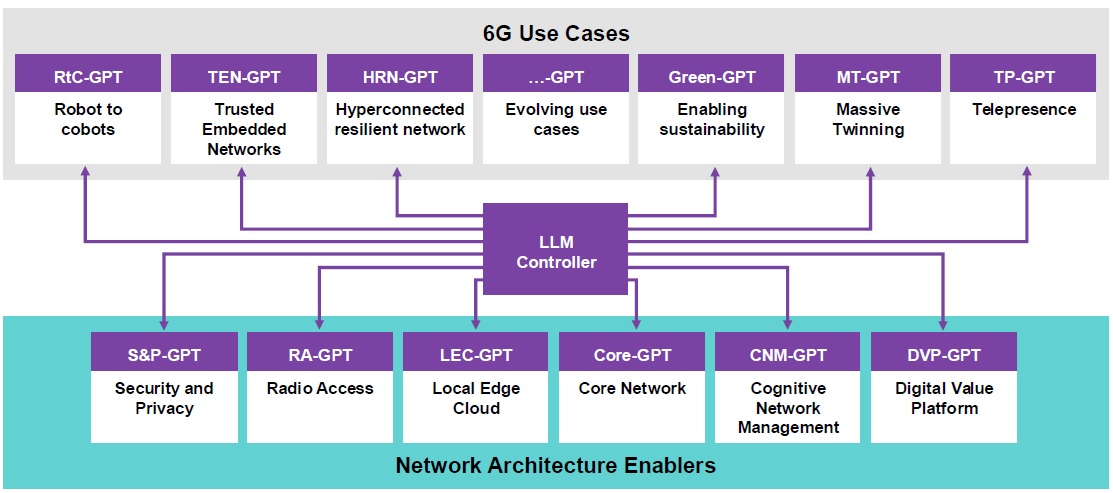
A recent white paper from Khalifa University explores the concept of AI-Native 6G Networks, focusing on their architecture, embedded intelligence, and the path toward fully autonomous connectivity. The paper provides a compelling starting point for a clear, structured discussion of what it truly means for a network to be “AI-native.” Rather than treating artificial intelligence as an external optimization tool, it frames AI as a foundational element, deeply integrated into every layer of the network. This perspective not only redefines how future communication systems will be designed and operated, but also sets the stage for understanding the transformative potential of 6G in enabling intelligent, self-managing, and adaptive connectivity.
The evolution of mobile networks has never been about speed alone. From 1G to 5G, each generation has introduced transformative capabilities, improving connectivity, enabling new services, and reshaping how people and industries interact. However, 6G represents something fundamentally different. It is not simply “5G but faster.” Instead, it marks a paradigm shift toward AI-native networks by design.
What does AI-native mean for 6G?
In previous generations, artificial intelligence (AI) has been used primarily as an add-on to enhance performance, optimize resources, or automate specific tasks. In contrast, 6G networks are being envisioned with AI embedded at their core. This means intelligence is not layered on top; it is woven into every aspect of the system.
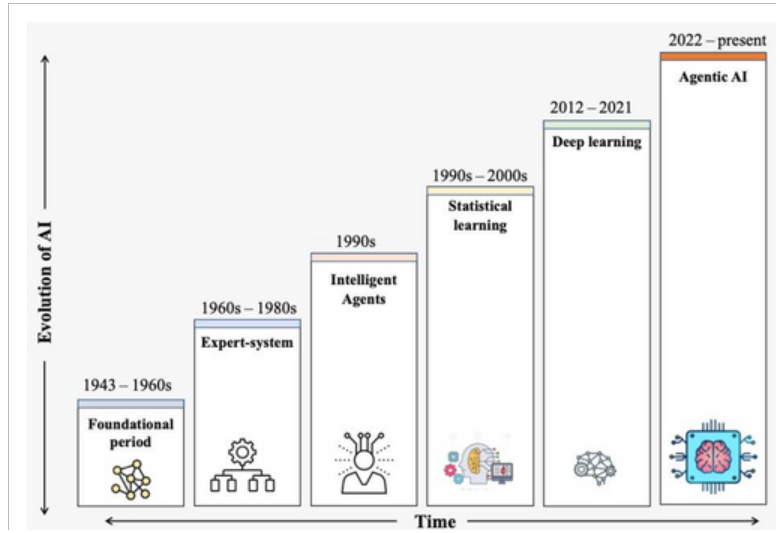
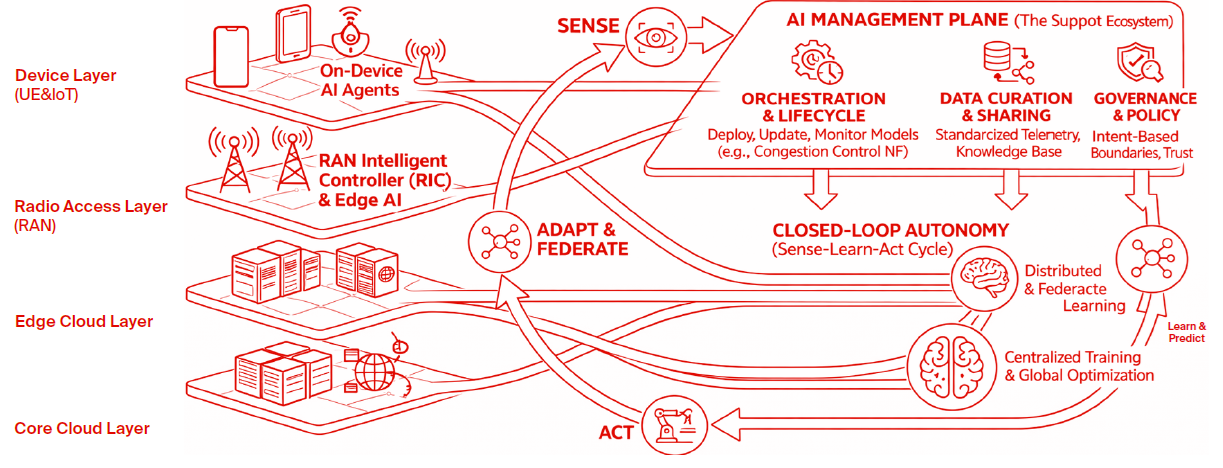
An AI-native network integrates sensing, reasoning, decision-making, and actuation across its entire lifecycle. The result is a system capable of autonomous, end-to-end operation, where networks can learn, adapt, and respond in real time without human intervention.
From automation to intelligence
The journey from 1G to 5G reflects a steady increase in software-driven capabilities and automation. With 6G, this evolution culminates in true network intelligence. The distinction between “AI-assisted” and “AI-native” becomes critical:
- AI-assisted networks (5G and earlier): AI improves existing processes.
- AI-native networks (6G): AI defines how the network operates from the ground up.
This shift introduces a new architectural concept: the AI plane, working alongside traditional control and user planes. AI functions are distributed across radio access networks (RAN), core networks, and edge environments, creating a deeply integrated intelligent ecosystem.
Enabling technologies behind AI-native 6G
Achieving this vision requires advances across multiple domains:
- Distributed cloud-edge computing: Bringing intelligence closer to users for real-time decision-making
- Data engineering: Efficient collection, processing, and sharing of massive datasets
- Specialized AI hardware: Accelerating machine learning tasks within the network
- Integrated sensing and communication: Allowing networks to perceive and understand their environment
- Open architectures: Supporting flexible, plug-in AI modules and innovation
Together, these technologies form the foundation for a highly adaptive and intelligent network infrastructure.
Transformative capabilities
AI-native 6G networks will go far beyond current capabilities. Key functionalities include:
- Self-optimization and self-healing: Networks automatically detect and fix issues
- Predictive resource allocation: Anticipating demand before it occurs
- Intent-based networking: Translating user needs into automated network actions
- Hyper-personalized services: Tailoring experiences in real time
These capabilities represent a qualitative leap from 5G, enabling networks that are not just reactive but proactive and cognitive.
Real-world use cases
The potential applications of AI-native 6G are vast and transformative:
- Ultra-immersive AR/VR experiences: Including real-time haptic feedback for the “metaverse”
- Autonomous mobility systems: Vehicles and infrastructure collaborating seamlessly
- Massive IoT and smart cities: Efficiently managing billions of connected devices
- Industrial automation: Digital twins enabling real-time monitoring and optimization
These scenarios demand ultra-reliable, low-latency, and intelligent connectivity, precisely what 6G aims to deliver.
Rethinking performance metrics
Traditional metrics like throughput, latency, and reliability remain important, but they are no longer sufficient. AI-native networks introduce new key performance indicators, such as:
- Learning accuracy of AI models
- Decision latency in autonomous operations
- Energy efficiency per AI inference
- Level of network autonomy
These metrics help measure not just how fast a network is, but how intelligently it operates.
Security, trust, and governance
Embedding AI deeply into network infrastructure raises critical challenges:
- Resilience to adversarial attacks targeting AI models
- Data privacy and protection in large-scale data environments
- Explainability and transparency of AI decisions
- Regulatory oversight of autonomous systems
Addressing these concerns is essential to building trust in AI-native networks.